


Stop reviewing content that’s already fit for purpose
TAUS EPIC uses intelligent Quality Estimation to filter your translations, ensuring your team only invests valuable human expertise where it is needed
What is Quality Estimation?
Quality Estimation (QE) is a technology that predicts the quality of a machine translation. While traditional quality checks are slow, expensive, and difficult to scale, especially where humans are involved, QE provides an instant, objective quality signal. With massive volumes of content to translate, most companies have no way to distinguish "good" translations from "misleading" ones. QE acts as a quality filter, analyzing your Machine Translation (MT) output to determine how likely it is to be "good enough" for your specific audience.
How does Quality Estimation work?
Our EPIC application evaluates translations in real-time by taking your source text and the machine-translated output to return an objective quality score.
The Scoring Logic:
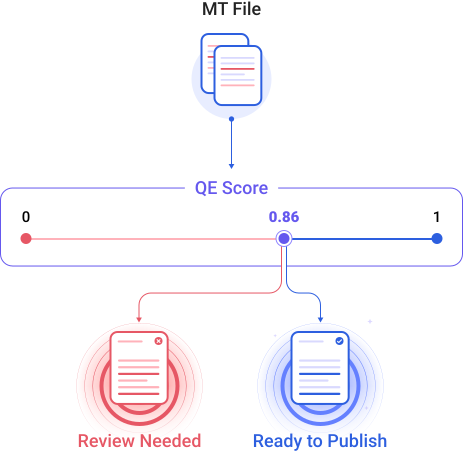
We provide a 0 to 1 score for every segment.
Automated Decision Support:
Based on this score, you can define your own "quality gate." Segments above your threshold go straight to production, while risky segments can be routed as per your workflow.
The EPIC Quality Gate:
MT Content is generated.
QE Scoring: EPIC assigns a real-time risk score.
Intelligent Routing: Risky content is sent for Automated Post-Editing (APE) or to humans for manual review; high-quality content is published immediately.
How do I know what QE score is "good enough" for my content?
There is no single "magic number" for quality. A score that is perfect for a user-generated support forum might be a disaster for a legal contract. At TAUS, we help you define your own Quality Gates based on your specific industry, content type, and risk tolerance.
The Baseline Model

If you are using a generic QE model, you’ll get a reliable "general purpose" score. It is excellent for high-volume, low-risk content where you just need to know if the translation is readable and safe.
The Custom Model Advantage

For brand-critical content—like marketing or technical documentation—a Custom Model is the difference between "readable" and "on-brand". Because a Custom Model is trained on your specific terminology and style, the resulting QE score is far more trusted. It understands your unique "definition of good".
Pro Tip: Don’t aim for 100% perfection across the board. Most successful enterprises use a tiered scoring strategy:
Score +0.85: "Publish-Ready" (Automated workflow).
Score 0.60–0.84: "Human-in-the-loop" (Standard post-editing).
Below 0.60: "Re-translate" (Or re-evaluate MT engine)
Why is QE essential for your business?
QE isn't just a technical metric; it is a business tool that allows you to control quality at scale without exploding your operational costs.
Risk Mitigation
Catch misleading or wrong translations before they go live.
Agile Scaling
Stop waiting for manual checks; get instant feedback on the performance of your MT engines.
Operational Efficiency
Review low-quality segments only.
How does QE fit into translation workflows?
QE is designed to be an engine-agnostic "neutral judge". Whether you use Google, DeepL, or Amazon, EPIC sits within your translation management workflows to ensure only the right content receives human attention.
The Manual Way
Slow, expensive human sampling
Subjective, context-dependent
Challenging to scale globally
The Epic Way
Instant, 100% automated coverage
Objective, data-driven score
Scales across any language pair



Start scoring your MT quality today.
(reclaim your localization budget in under 5 minutes)
Frequently Asked Questions
If you have more questions, we’re here to help support@taus.net
- Is QE a replacement for human linguists?
No. It is a decision support tool. It helps you decide where human effort is needed most.
- How do I know I can trust EPIC’s quality scores?
EPIC’s models are trained with curated data that has been purposefully screened and prepared for each use case(TAUS Data for AI) , ensuring the engine’s "judgment" is aligned with professional human standards. It doesn't guess; it uses contextual intelligence to mirror the decision-making of an expert reviewer. We recommend a brief calibration phase to align our engine’s sensitivity with your specific brand safety requirements.
- What ROI can I expect?
Customers typically see significantly reduced lead times for post-editing and average savings of 50% on total localization costs.